OCEANS 2026 Information
Please join us at the upcoming OCEANS CONFERENCE & EXPOSITION 2026 MONTEREY, CA
SEPTEMBER 21-24.
On the morning of September 21st, 2026 (Monterey, CA), Stefan Domino (COMERI/Stanford University) and Vadim Pavlov (Stanford University) will be hosting a half-day workshop entitled, Leveraging Computational Fluid Dynamics for Studies of Marine Life: Establishing Best Practices for the Discovery of Multiphysics Processes (workshop organizers, details, preliminary participants, and schedule information appear below). If you have any comments or suggestions on improvement, let us know.

Co-Organizers
Stefan Domino, Ph.D.
COMERI/Stanford University

Vadim Pavlov, Ph.D.
Stanford University

Dr. Domino’s research interest rests within low-Mach fluid mechanics methods development for marine ethology-based systems that drive the coupling of mass, momentum, species and energy transport. His core research resides within the intersection of physics elucidation, unstructured numerical methods research, V&V techniques exploration, and high-performance computing and coding methods for multiphysics turbulent flow applications. Stefan is the founder of the 501(c)(3) Computational Marine Ethology Research Institute, is a former Distinguished Member of the Technical Staff at Sandia National Laboratories, and supports Stanford's School of Engineering including roles as an Adjunct Professor and Visiting Senior Fellow at the Center for Turbulence Research (Stanford Visiting Scholar).
Dr. Vadim Pavlov's research interest is on the intersection of biomechanics, fluid dynamics, modeling, and movement ecology. It includes tuna-informed enhanced motion control of aquatic robotics, bio-telemetry tag design for tracking marine megafauna, and hydrodynamics of cetaceans. His current work in collaboration with the Stanford Center for Turbulence Research is focused on swimming energetics of cetaceans. It explores the functional links between morphology, biomechanics, and cost of locomotion, resulting in species-specific energetic profiles. This study has direct implications on marine mammals’ conservation and assessment of the survival risks and anthropogenic impact.
Workshop Overview, Goals and Outcomes
Over the last two decades, advances in numerical methodologies and their deployment on high-performance computing platforms have transformed numerous engineering disciplines, facilitating both deeper physical insight and improved design for multiphysics applications. Such modeling and simulation tools have reshaped the engineering analysis landscape, driving advancements in renewable energy systems design, strengthening fire safety mitigation strategies, and advancing environmental fluids characterization. This workshop explores how recent high-fidelity computational advances can be leveraged to transform understanding of biological systems via morphological designs in maneuvering and cruising specialists (e.g., drag quantification and energy budgets) to advancing the characterization of marine ethology (e.g., thermoregulation of ocean sunfish, functional design quantification of male pufferfish nest structures, etc.).
The workshop objectives are to capture current exemplars for computational approaches that are focused on solving marine-based use cases, while promoting the open sharing of knowledge, experience and current challenges/opportunities. Our workshop will provide examples that illustrate a science-based workflow, including essential attributes such as 1) robust solid geometry definition and creation; 2) meshing approaches (e.g., focused on quality and suitability to resolve critical features of the application); 3) the computational fluid dynamics (CFD) engine that includes exercising an appropriate set of numerical schemes, and finally; 4) analysis and discovery of multiphysics processes that are commonly found in marine-based use cases. Pitfalls and lessons learned for each aspect of this workflow will be identified, as will best practices.
The workshop will foster a focused set of technical discussions with leaders in the computational, multiphysics disciplines -- some of whom are new to the marine-based application space. Identified novel partnerships for a targeted set of funding streams represents a key objective, as does identifying strategies for community and societal participation (i.e., broader impacts). We hope to exit the workshop with a shared vision and alignment of available tools and core competencies, along with a set of current challenges that must be closed for the computational community to achieve success.
Additional
Preliminary Set of Speakers
Schedule
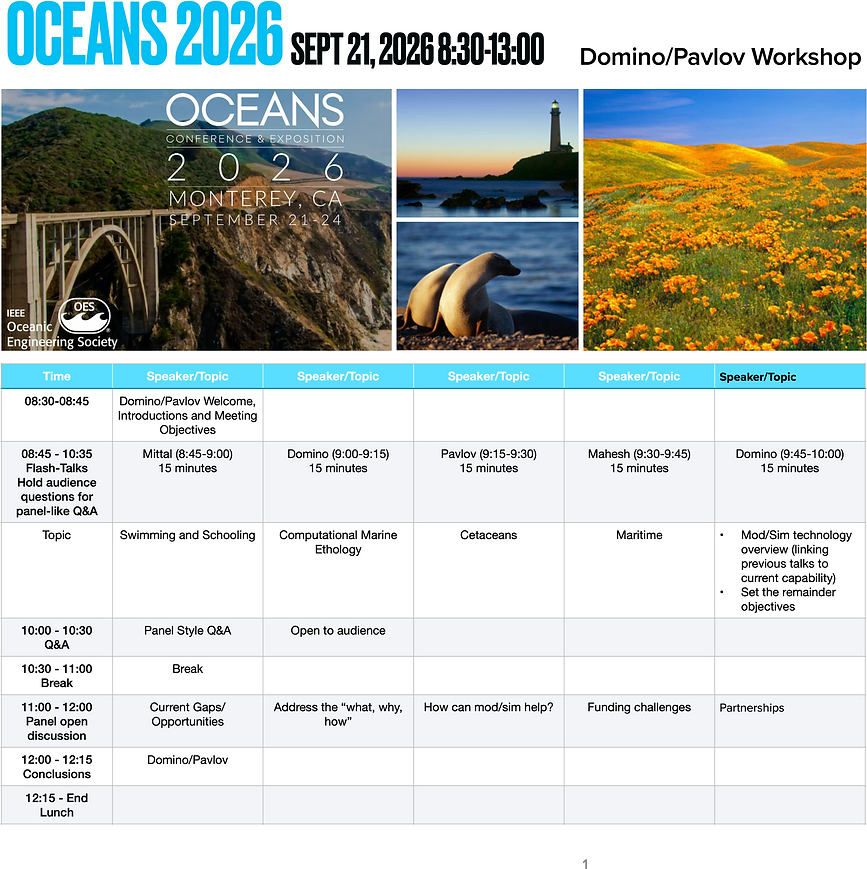
Our tentative schedule (see the formal OCEANS webpage for specifics) includes a concept of four flash presentations consisting of 15 minutes to overview current examples of linking computational tools/approaches towards marine use cases.
Following the set of flash presentations (with an end overview linking each topic), presenters will take a panel format for detailed Q&A for each flash presentation.
After a break, where informal discussion and networking will take place, the workshop will conclude with a panel discussion that concentrates on current successes, areas for improvement, and gaps in capability/information. We will also focus on the "what, why, and how" aspects to this research theme, in addition to social outreach ideas/concepts..